quinta-feira, 13 de novembro de 2008

Investindo em Relacionamentos


Tecnologia e alta eficiência no mercado de trabalho actual trouxeram muitos benefícios, mas também acarretaram consequências onerosas. Enquanto lidamos, por exemplo, com inundações de e-mails, correio de voz, etc. e a responsabilidade crescente no nosso emprego, a nossa capacidade para desenvolver e manter amizades permanentes enfrenta, a cada ano, gigantescos desafios.

Muitos de nós no mundo profissional e empresarial - inclusive eu mesmo - têm recebido treinamento nas áreas de administração de tempo e gestão de prioridades, na procura duma maior eficiência profissional. Melhora a produtividade e ajuda-nos a eliminar itens menos ou não necessários da lista diária de "Coisas para Fazer". Contudo, estou preocupado com a maneira como estas exigências crescentes estão a afectar perigosamente os nossos relacionamentos de longa data.

Um factor importante, geralmente esquecido na nossa busca incansável pelo sucesso, é a realização e o triunfo que normalmente resultam do trabalho conjunto de pessoas que partilham os seus talentos e capacidades, na busca de uma missão comum. Os meus amigos mais chegados são aqueles que frequentemente se apresentaram para oferecer ajuda quando eu mais precisei. Porém, as nossas agendas lotadas estão a tornar cada vez mais difícil cultivar esses relacionamentos valiosos. Por isso, fico às vezes a imaginar, se no meu funeral comparecerão apenas as pessoas que se sentirão obrigadas a estar lá ou aquelas seriamente comprometidas com a nossa amizade.

No capítulo 10 do Evangelho de Lucas, na Bíblia, há um relato conhecido sobre um momento em que Jesus visitou a casa das irmãs Maria e Marta. Esta era perfeccionista e gastava muito tempo a trabalhar diligentemente, preparando uma refeição para Jesus e os Seus amigos. Enquanto isso, Maria, ao contrário, preferia, sentar-se aos pés de Jesus, devotando tempo para simplesmente estar com o seu Senhor, em vez de ficar atarefada a fazer qualquer coisa para Ele.

A Marta aborreceu-se muito com a irmã por não a ajudar nos preparativos. Não podemos culpá-la. Obviamente havia muita coisa importante a ser feita e a ajuda da irmã era bem-vinda. Aparentemente ela também ficou aborrecida com Jesus, por não ter repreendido a Maria dizendo-lhe que se ocupasse de alguma tarefa.

Em atenção à queixa de Marta, Jesus agiu de modo surpreendente: “Respondeu o Senhor: Marta, Marta, andas preocupada e aflita com tantas coisas, quando uma só é necessária. Maria escolheu a melhor parte, que não lhe será tirada” (Lucas 10:41).

Ao reflectir neste relato - óptimo lembrete para mim e espero que para si também - percebi que os relacionamentos que cultivamos são mais significativos e mais importantes do que as tarefas que realizamos. Cumprir metas é muito importante, mas precisamos de lembrar-nos do valor dos relacionamentos e reconhecer quando é mais importante colocar de lado os projectos, mesmo que por alguns instantes, e investir tempo com um amigo.

O nosso trabalho ficará sempre à espera da nossa atenção e acção. Mas negligenciar amizades pode enfraquecê-las e até mesmo extingui-las. Pense nisto: “Há alguém que precisa contactar hoje… alguém importante para si… um relacionamento demasiado importante e precioso que não pode nem deve perder?


Adaptado, com permissão, de "Momentos de Integridade com Rick Boxx", um comentário semanal acerca da integridade no mundo dos negócios, a partir da perspectiva cristã. Tradução de Mércia Padovani.


Questões para Reflexão/Discussão

1. Algumas pessoas são, por natureza, mais fáceis de se relacionarem do que outras. Qual é a sua capacidade para manter e desenvolver relacionamentos, tanto pessoalmente como profissionalmente – ou, no seu entender, considera esta questão menos importante? Comente as suas razões.

2. Quais são os maiores obstáculos ou impedimentos na construção e desenvolvimento de amizades importantes que encontra no seu local de trabalho? Acha que a possibilidade em estabelecer bons relacionamentos está a mudar positivamente ou negativamente?

3. Lembra-se de ter perdido ou estar a deteriorar-se algumas amizades importantes por não conseguir dedicar tempo de qualidade? Que passos acha que deveriam ser dados ou deseja dar para evitar que tal aconteça no futuro?

4. Como responderia se alguém lhe pedisse conselho acerca de como equilibrar entre as solicitações e realizações no trabalho e a questão importante de proteger os relacionamentos?

NOTA: Se possuir uma Bíblia e desejar aprofundar outras passagens sobre este assunto, consulte: Provérbios 17:17, 18:24, 27:10, 27:17; João 15:13-15

CRIES FOR HELP FROM ZIMBABWE


“Half the admissions end up in the mortuary.” Doctors in Zimbabwe have sounded an alert that patients are dying unnecessarily because of lack of medical supplies.


“There is no liquid paracetamol, no materials for dressings, no burn cream, no antiseptics, no drips, no surgical gloves, limited antibiotics. All these are required and need to be purchased by family members that can barely afford to survive on a daily basis. No sterile burn environment for burn victims, ward curtains are torn, windows are broken, sheets are worn, the food (when available) is supplied but without nourishment (over the last four weeks patients have been fed a small portion of sadza/rice with cabbage boiled in salt water). Children that are malnourished are being sent home to die as the required protein formula is unavailable. X-rays are unable as there is no film…there has been no food provided to patients for six days. Those without families to provide food – go hungry! Daily the nurses suffer heartache as they watch helplessly as patients, particularly, children, die unnecessarily! Constant frustration of not being able to put their knowledge into practice due to the lack of medical supplies can only be disheartening….”

These are just some of the quotes of recent reports received by our mission. One person writes of: “Deaths, infections, no food, no medicines, no anesthetic, no pain relief,…incredibly traumatic, infections rife and pain unbearable…”

“In the hospital we cannot feed the starving children, at least an home they can scrounge for things. We only keep those that we see won’t make it at home. We’ve lost the battle before we have fought it…”

“Malnutrition is a silent emergency that affects the young children and they die quietly.”

Doctors have reported children’s wards filled with tiny patients, their bodies swollen with oedema, lying deathly still. A common sight is the oversized head and sparse hair, characteristic of kwashiorkor, a malnutrition which usually affects very young children. One doctor reported kwashiorkor in an eight-year old boy: “that is highly unusual, it is mostly confined to two and three year olds. That’s an indication of how serious the hunger is.”

A doctor in a mission hospital reported that their hospital lacked life-saving protein supplements, and were being forced to use diluted milk. The children were meant to be fed six times a day, but they only had enough for once a day, and then nothing for the next five days.

One doctor reported a mother dying in childbirth leaving her baby born HIV positive. The grandmother refused to take the infant home as she could not feed it. So the baby was left at the hospital. In despair the doctor declared: “It’s starvation all over, starving, starving, starving!”

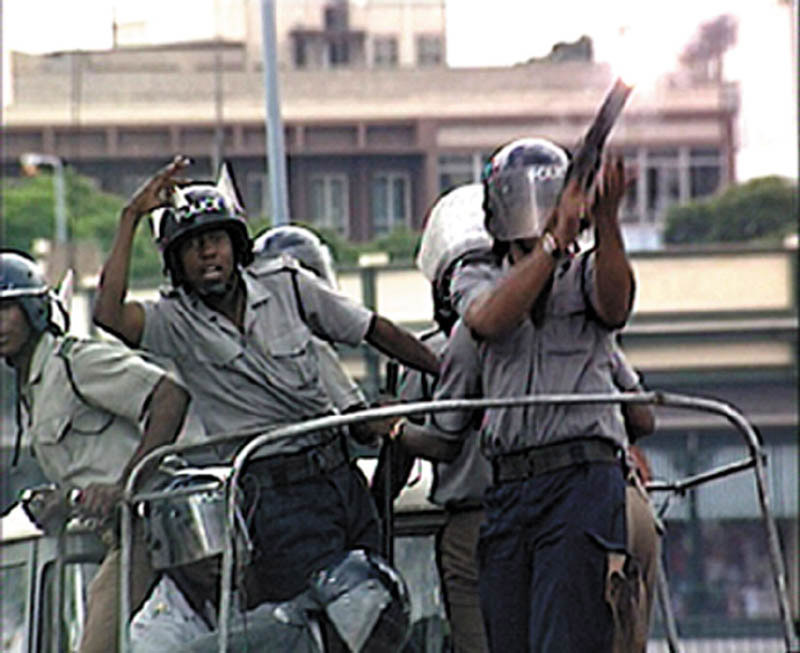
Since Marxist dictator Robert Mugabe, and his ZANU-PF party, unleashed a wave of destruction and confiscation upon the once productive white commercial farms, starvation was inevitable. Having destroyed the productive agricultural economy of Zimbabwe, ZANU has achieved the highest unemployment (90%), the highest rate of inflation (231 million percent) and the lowest life expectancy (30 years) in the world today. Approximately half of the total population of Zimbabwe have fled across the borders.

Educational Catastrophe

The national suicide, initiated by the destruction of the productive white farms, has not only led to the economic meltdown and medical crisis, but also an educational catastrophe. Since January 2008 there has been a total of only 23 days of education for the 4.5 million students in Zimbabwe. Now the government has cancelled the academic year completely, declaring that their will be no examinations this year.

City schools have been handicapped by water and power cuts. One primary school has had no water for 5 years. Boarders at hundreds of rural schools have been sent home because there was no food for them.

When teachers went on strike they were attacked by ZANU-PF militia. Numerous teachers were murdered and thousands were brutally beaten. Schools were ransacked and used as torture centres. Many teachers disappeared and others were too afraid to return. Now that teachers have had their salaries doubled, to less than US$10 per month, they have barely enough to cover their bus fares and food for four days. In some government schools, students have resorted to sawing up benches for wood.

Zimbabwe’s four leading universities failed to open and the Vice Chancellor of the University of Zimbabwe explained that the university had no water, no electricity and no funds.

Cases of cholera have broken out because of the very poor sewerage system and lack of adequate water supply. “Our water supply is constantly being cut off. You never know when it may come back again. We keep water in every possible container.”

Some people in the capital city have reported power cuts lasting for weeks, once for up to 28 days at a time.

The rains are due to start but there is no maize seed or fertilizer available. 5 million people face starvation in Zimbabwe.

One medical person writes: “Are we prepared to help fight the battle for our children to be able see in another season, or do we just walk away...? I firmly believe that even if we make a difference to only one child’s life – we have made a difference!”

Serving the Suffering

In the light of the colossal humanitarian catastrophe occurring just north of our border in Zimbabwe, our mission is planning additional field trips to deliver life-saving supplies and medicines to doctors and nurses, pensioners and pastors, widows and orphans - who are praying for the desperately needed materials which we can deliver. Of course, we cannot help everyone, but we can help some. It is our earnest prayer that the Lord would use and multiply the inadequate supplies that we can provide as He used the loaves and fishes to feed the thousands.

If you have skills and resources which can enable us to serve the suffering in Zimbabwe, please do contact us:


info@frontline.org.za

Yours for the fulfillment of the Great Commission of our Lord Jesus Christ.

Dr. Peter Hammond, Director

Frontline Fellowship

P.O. Box 74

Newlands, 7725

Cape Town, South Africa

Tel: (021) 689-4480

Fax: (021) 685-5884

Email: admin@frontline.org.za

Website: www.frontline.org.za